
A window that won’t open or close properly can be frustrating, especially when it affects ventilation, comfort, or home security. Many window operating problems are caused by worn hardware, damaged crank mechanisms, loose hinges, faulty locks, or frame alignment issues.
Understanding the common causes can help homeowners identify warning signs and determine whether maintenance, hardware replacement, or professional window repair may be necessary.
1. Window Won’t Open or Close? Common Causes
Residential windows use different operating systems depending on their design. Casement and awning windows often use crank operators, while sliding windows move along tracks. Other windows rely on balances, hinges, or specialized hardware.
When a window becomes difficult to operate, the problem may involve one or more components.
Common causes include:
- Broken or worn window crank operators.
- Damaged hinges or friction stays.
- Faulty locks and locking mechanisms.
- Dirt or debris inside tracks.
- Window sash misalignment.
- Damaged window balances.
- Warped or deteriorated frames.
The correct repair depends on the window type and the condition of its hardware.
2. Broken Window Crank or Operator Mechanism
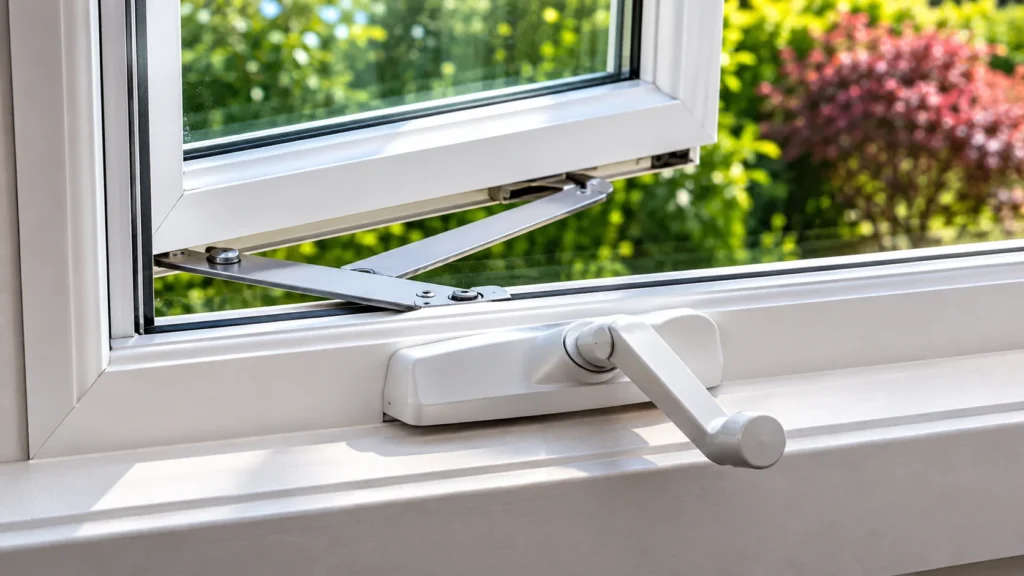
Casement and awning windows often use a crank handle connected to an operator mechanism.
When the operator becomes worn or damaged, the handle may turn without moving the window. In other cases, the mechanism may become stiff or stop before the sash reaches its fully open or closed position.
Signs of a faulty window operator
- The crank handle spins without moving the window.
- The window opens only partially.
- The handle is difficult to turn.
- The operator makes grinding or clicking noises.
- The window cannot be pulled closed properly.
Some problems involve a loose handle, while others require replacement of the complete operator assembly.
Replacement parts must be compatible with the window’s design, dimensions, and mounting configuration.
3. Damaged Window Hinges
Hinges support the window sash and guide its movement.
Over time, hinges may become worn, corroded, bent, or loose.
A damaged hinge can cause the sash to drop or shift out of alignment, making the window difficult to close.
Common warning signs
- The window rubs against the frame.
- One corner of the sash appears lower than the others.
- The window does not sit evenly when closed.
- The sash feels loose or unstable.
- The window requires excessive force to operate.
In some cases, hinge replacement and proper alignment can restore normal operation without replacing the entire window.
4. Window Lock and Latching Problems
A window may open and close but still fail to lock securely.
This can happen when the locking hardware becomes worn, damaged, or misaligned.
Common problems include broken handles, damaged keepers, faulty multipoint locking components, and window sashes that no longer align correctly with the frame.
Avoid forcing a lock that does not engage properly. Excessive pressure can damage the mechanism or surrounding window components.
A technician can determine whether the problem requires hardware replacement, adjustment, or additional window repairs.
5. Sliding Windows That Get Stuck
Sliding windows operate along horizontal tracks using guides, rollers, or other supporting components.
When dirt builds up inside the track, the window may become difficult to move.
Other causes include damaged guides, worn rollers, a distorted frame, or a sash that has shifted out of alignment.
What can homeowners check?
Inspect accessible tracks for visible debris, damaged components, or obstructions.
Loose dirt can often be removed with a vacuum and soft brush. Clean accessible surfaces using products compatible with the window materials.
Avoid forcing a window that is stuck, especially when the glass or frame appears damaged.
If cleaning does not improve movement, a mechanical or alignment problem may require professional attention.
6. Window Sash Alignment Problems
A properly aligned window should fit evenly within its frame and operate without excessive friction.
When the sash becomes misaligned, it may rub against the frame, leave uneven gaps, or fail to close completely.
Possible causes include worn hinges, damaged hardware, frame movement, or previous installation problems.
Alignment issues can also interfere with weatherstripping and locking performance.
A professional inspection can help determine whether adjustments or replacement components are needed.
7. Broken Window Balances
Some vertically sliding windows use balance systems to support the weight of the sash.
When a balance fails, the window may become difficult to lift, fail to remain open, or drop unexpectedly.
A sash that will not stay in position may create an injury risk.
Window balances can contain components under significant tension. Replacement should be performed using compatible parts and appropriate procedures.
8. When Should You Call a Window Repair Technician?
Professional assistance may be appropriate when:
- The window cannot open or close.
- The crank handle turns without operating the sash.
- Hinges or supporting hardware are visibly damaged.
- The window does not lock securely.
- The sash is sagging or misaligned.
- A sliding window repeatedly gets stuck.
- The window drops or will not stay open.
- The frame or glass is damaged.
Some window problems can be resolved through hardware replacement or adjustment. Others may require more extensive repairs.
Accurate diagnosis helps avoid replacing an entire window when a targeted repair may be possible.
9. Repair or Replace a Window?
Not every operating problem requires a new window.
Many issues involving crank operators, hinges, locks, balances, and other mechanisms can be repaired using compatible replacement parts.
However, replacement may be more appropriate when the frame is severely deteriorated, the sash is significantly damaged, suitable parts are unavailable, or the overall window condition makes repair impractical.
The best option depends on the specific problem, the age and condition of the window, and the availability of replacement components.
For additional information about repairing window hardware and improving window efficiency, see Natural Resources Canada’s guide to upgrading windows and exterior doors.
10. Window Repair & Mechanism Replacement in Toronto & the GTA
AEO Services Inc. provides residential and commercial window repair services throughout Toronto, the Greater Toronto Area, and surrounding Southern Ontario communities.
Our services include troubleshooting and replacement of window operators, cranks, hinges, locks, balances, and other operating hardware, as well as glass repair and replacement.
If your window is difficult to open, close, or lock, contact AEO Services to discuss your repair needs and available service options.
Need Window Repair?
Submit an online service request and describe the problem. You can also upload photos of the window and damaged hardware to help our team review your inquiry.
Frequently Asked Questions
Why does my window crank turn without opening the window?
A spinning crank may indicate a stripped handle, damaged gears, or a failed operator mechanism. The exact cause depends on the hardware design and condition.
Can a broken window crank be replaced?
Many casement and awning window crank operators can be replaced with compatible components. Part availability varies by manufacturer and model.
Why won’t my casement window close all the way?
Possible causes include damaged hinges, faulty crank operators, frame misalignment, loose hardware, or an obstruction preventing normal sash movement.
Can window hinges be repaired?
Some hinge problems can be resolved through adjustment or hardware replacement. Severely worn or damaged hinges may need to be replaced.
Should I replace my entire window if the mechanism is broken?
Not necessarily. Many operating problems can be addressed through targeted repairs, depending on the window’s condition and the availability of suitable parts.